Armenia
Armenia officially the Republic of Armenia is a mountainous country in the South Caucasus region of Eurasia. Located at the crossroads of Western Asia and Eastern Europe, it is bordered by Turkey to the west, Georgia to the north, the de facto independent Nagorno-Karabakh Republic and Azerbaijan to the east, and Iran and the Azerbaijani exclave of Nakhchivan to the south. Total area of Armenia is 29,743 km2 (11,484 sq mi) with population little over 3 million. Today the republic had developed a modern industrial sector, supplying machine tools, textiles, and other manufactured goods to sister republics in exchange for raw materials and energy. Recently, the Intel Corporation agreed to open a research center in Armenia, in addition to other technology companies, signaling the growth of the technology industry in Armenia.
Armenia is a unitary, multi-party, democratic nation-state with an ancient cultural heritage. The Kingdom of Armenia was established in the 6th century BC, after the fall of Urartu; it became the first state in the world to adopt Christianity as its official religion, in the early years of the 4th century (the traditional date is 301 AD). For this reason, Armenia is often referred to as the "first Christian nation." An Armenian principality and later a kingdom, known as Cilician Armenia, existed on the coast of the Mediterranean Sea between the 11th and 14th centuries.
By the 19th century, the traditional Armenian homeland was divided between the Ottoman and Russian empires. During World War I, the Armenians living in their ancestral lands in the Ottoman Empire were systematically exterminated in the Armenian Genocide. After almost 600 years of statelessness, Armenia was able to become independent in 1918; however, the First Republic of Armenia was surrounded by hostile countries that forcibly ended its independence in 1920. Between 1920 and 1991, Armenia was part of the Soviet Union. The modern Republic of Armenia became independent in 1991.
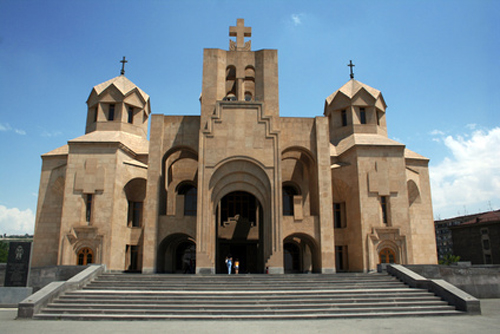
The Republic of Armenia recognizes the Armenian Apostolic Church, the world's oldest national church, as the country's primary religious establishment. Armenians have their own unique alphabet, which was invented by Mesrop Mashtots in 405 CE. Armenia is divided into ten provinces , with the city of Yerevan having special administrative status as the country's capital.
Yerevan
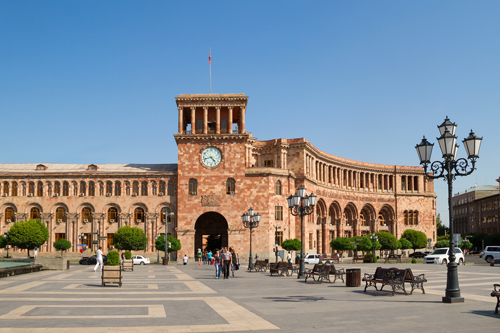
Yerevan is the capital and largest city of Armenia and one of the world's oldest continuously inhabited cities. Situated along the Hrazdan River, Yerevan is the administrative, cultural, and industrial center of the country. It has been the capital since 1918, the thirteenth in the history of Armenia.
The history of Yerevan dates back to the 8th century BC, with the founding of the fortress of Erebuni in 782 BC by king Argishti I at the western extreme of the Ararat plain. Erebuni was "designed as a great administrative and religious centre, a fully royal capital." After World War I, Yerevan became the capital of the First Republic of Armenia. The city expanded rapidly during the 20th century as Armenia became part of the Soviet Union. In a few decades, Yerevan was transformed from a provincial town within the Russian Empire, to Armenia's principal cultural, artistic, and industrial center, as well as becoming the seat of national government.
With the growth of the economy of the country, Yerevan has been undergoing major transformation as many parts of the city have been the recipient of new construction since the early 2000s, and retail outlets such as restaurants, shops, and street cafes.
Today Yerevan has over 1 million people which makes the city home for more than 30% of the total population of Armenia. Yerevan was named the 2012 World Book Capital by UNESCO.